
Summary
There are so many ways you can market your music with videos! You just have to find something that works for you, that you feel comfortable making, and preferably a video style that's repeatable. Then get posting and try not to care about what people think. This guide is my honest take on social media for musicians in 2026, covering how to promote music on TikTok and Instagram without a budget, a team, or any real video skills. There are some fantastic content creators that make top class videos, but there are also many people doing simple things and going viral. Work smart, not hard!
Why "Watch Me Make This Beat" Isn't Working Anymore
Showing the process of how you make music is only one part of it, and if you make it in a normal way, it's generally not that interesting anymore. The majority of users on TikTok and IG have an extremely low attention span and have seen everything multiple times.
That isn't just a feeling, it's measurable. Psychologist Gloria Mark at UC Irvine has been tracking how long people stay on one screen before switching since 2004. Back then it was around two and a half minutes. By 2012 it had dropped to about 75 seconds, and in recent years it sits at roughly 47 seconds, a figure other researchers have replicated with their own logging methods [1][2]. That's the average across all screen activity, including work. On a scrolling feed built specifically to make switching effortless, you get a lot less than that.
So don't stop posting studio content, just don't make it your whole strategy. If someone doesn't know who you are, they're not going to watch you drag a MIDI clip around for 20 seconds. They need a reason to care almost immediately, and that reason comes from knowing who you're making the video for, not from what software you're using.
The 8-Step Social Media Plan for Independent Artists
Here's the process I'd recommend if you're starting from nothing on TikTok or Instagram Reels as a musician:
- Write down exactly who your ideal audience are. Be specific. Not "people who like sad music" but their age, where they live, and what they're doing when they'd have your song on.
- Try to understand them. What stereotypes and hobbies do those people usually have, AND what triggers them emotionally? This is the part almost everyone skips, and it's the part that makes someone stop scrolling.
- Work out if your music is perfect for a specific type of mood or theme, maybe based on the lyrics. Songs that clearly belong to a moment get used and shared far more than songs that are simply good.
- Then tell AI all of the above to brainstorm some video ideas based on what you have written down, OR caption ideas to place on top of your video if you already have recordings. The ideas you get back are only as good as the context you give it, which is why the first three steps come first.
- Start making and posting as much as you can initially with a few different ideas. Then after a month, see if one type of video did better than others, and which ones you enjoyed making. Both of those matter, because you won't stick with a format you hate doing.
- Try the different versions. If it's the exact same video, then do trial reels on IG so you're comparing properly instead of guessing.
- Then whatever worked best, make 30 videos like that one. This is the step where most artists give up and start again with a brand new idea. Don't do that.
- VIRAL :D I have faith in you!
The First 3 Seconds, and Why Everyone Bangs On About Them
The 3 second rule gets repeated so much it sounds like made up advice, but the platforms' own numbers back it up. TikTok for Business found that more than 63% of the videos with the highest click-through rates made their central message or subject clear within the first three seconds [3]. Meta's guidance for mobile feed content is similar, with the average piece of feed content holding attention for somewhere around 1.7 seconds before a decision gets made [4]. Industry analysis of TikTok also suggests retention in that opening window is treated as a separate signal by the algorithm, so a weak start doesn't just lose that viewer, it limits how many people ever get shown the video at all [5].
You'll also see the "humans have an 8 second attention span, less than a goldfish" line everywhere. It traces back to a 2015 marketing report and has been picked apart a lot since, so I wouldn't lean on it. The screen switching research is the sturdier stuff [1][6].
The practical takeaway for an artist is boring but true. Whatever your video is about needs to be obvious before someone has finished deciding whether to swipe. No slow intro, no logo, no "hey guys". Just get to it.
How to Actually Analyse Your Videos
When you get to step 5, don't just look at the view count and move on. Try analysing it in more detail:
- How much are the first 3 seconds likely to keep someone watching?
- Is there a reveal of some kind at the end?
- Is the video too long for what it's actually saying?
- Should you cut out more of the gaps between things to make the pace faster?
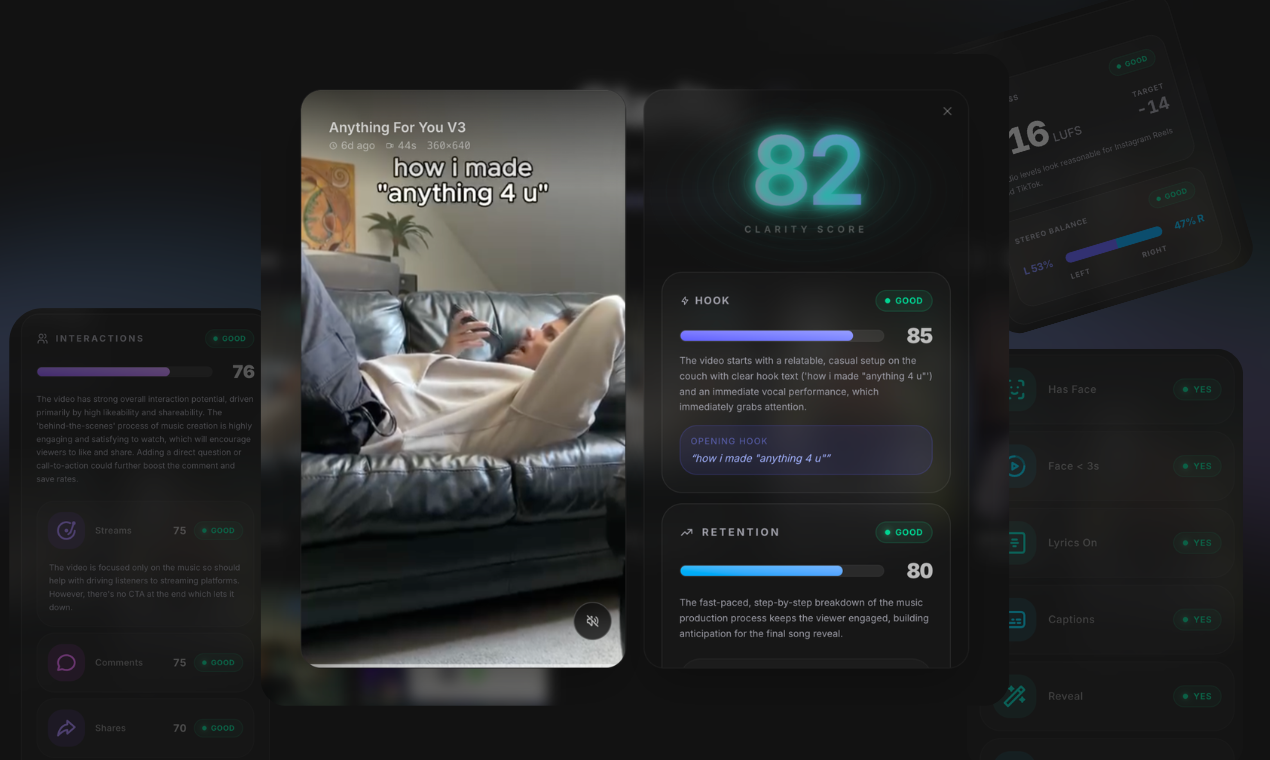
This is genuinely hard to do on your own videos. You've watched yours 40 times while editing, so you have no idea how it lands for someone seeing it cold. That's why I added Clarity to MusicMinutes. You upload a video and it gives you honest, specialist feedback in about 30 seconds, scored against what works for musicians, with clear fixes you can make before you post. It's free to use 3x per month and it's really designed for small artists. If you're not used to making content, you might learn something within a couple of uploads.
TikTok vs Instagram for Musicians
Post to both. They're both short form video, the editing work is identical, and cross posting costs you nothing except a re-upload.
TikTok is usually better for reaching people who have never heard of you, because the algorithm will happily push a video from an account with 12 followers. Instagram Reels tends to be better for turning people who already know you into actual fans, and it's where curators, promoters and other artists are more likely to check you out properly. Trial reels also make IG the better place to test variations of the same video.
Key Takeaways
- Pick a video style that's repeatable and that you're comfortable making, because you have to be able to keep it up.
- Define your ideal listener properly before you write a single video idea.
- Make your subject obvious in the first 3 seconds. The data is very consistent on this one.
- Emotional relevance and pacing matter far more than production value.
- Post volume first, review after a month, then commit hard to the format that won.
- Get feedback on your hook, pacing and length before posting, not after.
- Try not to care what people think. Most of them aren't watching yet anyway!
Frequently Asked Questions
How often should musicians post on TikTok and Instagram?
As often as you can keep up without burning out. In your first month, go for volume and variety so you have enough data to spot a pattern. After that, consistency matters more than frequency. Three decent videos a week beats fourteen rushed ones followed by a month of nothing.
Is the 3 second rule on TikTok real?
It's a simplification, but it's based on real numbers. TikTok's own research found the majority of its highest click-through videos established the subject within the first three seconds [3], and early retention appears to feed directly into how widely a video gets distributed [5]. Treat it as a floor, not a gimmick.
Do I need good equipment to promote my music on social media?
No. Plenty of simple phone shot videos outperform highly produced ones. Your hook, your pacing and how relevant the video is to a specific type of person all matter far more than your camera.
Is it okay to use AI for content ideas as an artist?
Yes, as a brainstorming partner. It works best when you feed it proper context about your audience, your mood or theme, and your lyrics. Give it nothing and you'll get the same generic ideas everyone else is posting.
How do I know if a video is good before I post it?
Check your first 3 seconds, your pacing, your length, and whether there's any payoff at the end. If you want a second opinion, Clarity on MusicMinutes scores your video against what works for musicians and tells you what to fix, with 3 free analyses per month.
Does social media replace Spotify playlist pitching?
No, they work well together. Video builds an audience that already cares about you, while organic playlist placements bring in listeners who would never find you on TikTok. Most independent artists get the best results doing both around a release.
Summary
You don't need to be a great videographer to grow on social media as a musician. You need a repeatable format that connects with a clearly defined audience, and the patience to make 30 of them instead of one of everything. Define your listener, work out what moves them, brainstorm around that, post a lot, review honestly, and double down on whatever worked.
Sources
- American Psychological Association, Speaking of Psychology: Why our attention spans are shrinking, with Gloria Mark, PhD. apa.org
- University of California, Can't pay attention? You're not alone, interview with Gloria Mark, UC Irvine. universityofcalifornia.edu
- TikTok for Business creative research, cited in Clouted, TikTok Hook Performance Statistics. clouted.com
- Meta mobile feed attention benchmarks, summarised in Meta advertising best practice guidance. facebook.com/business
- TTS Vibes, TikTok First 3 Seconds Hook Retention Rate Statistics, industry analysis of early retention and distribution. insights.ttsvibes.com
- Gloria Mark, Attention Span (Hanover Square Press, 2023). gloriamark.com
Disclosure: This guide is written by Paul Nicholls, founder of MusicMinutes and an independent artist with 1M+ Spotify streams. Features and figures are accurate as of 19/08/2026.